
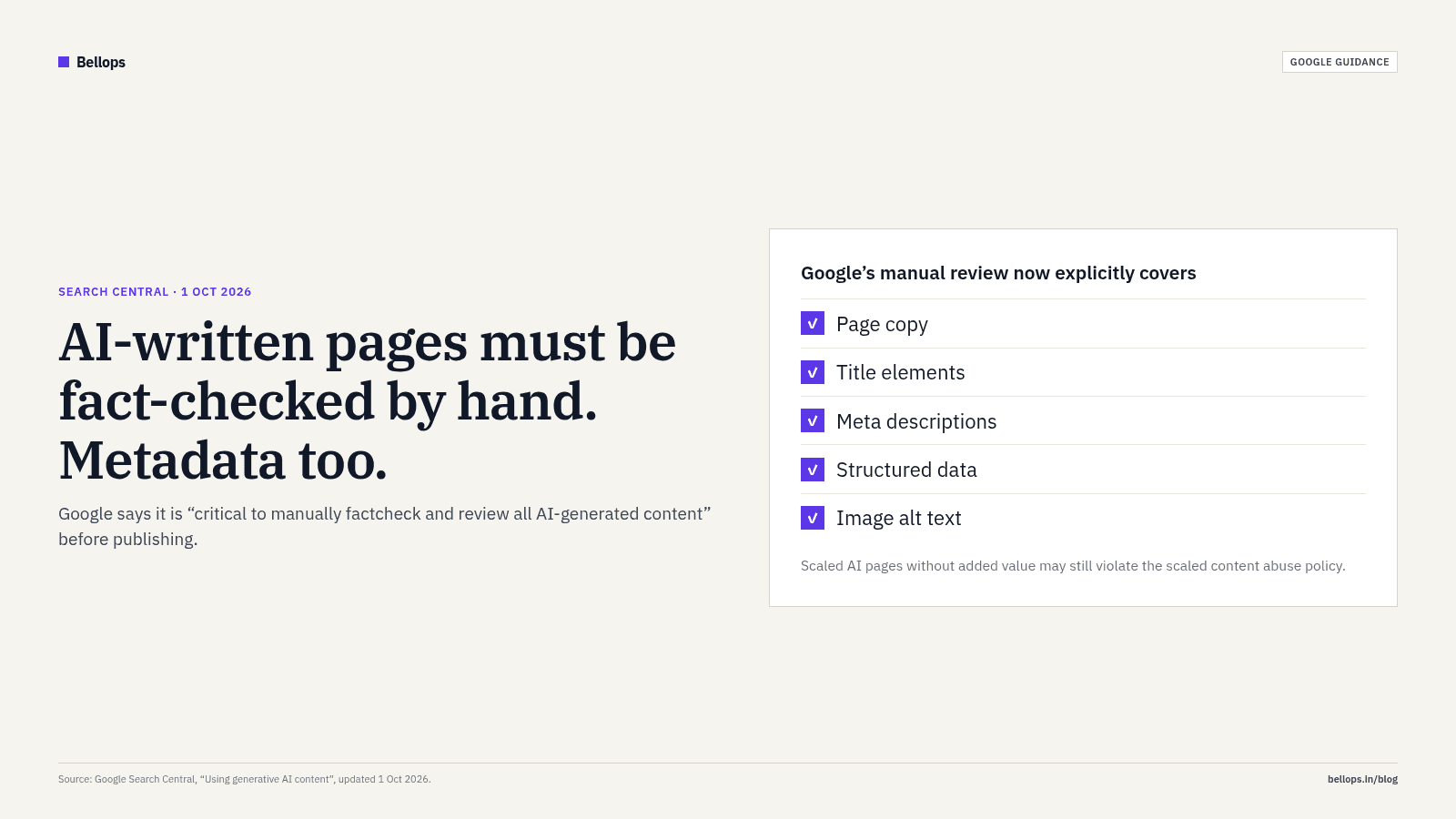
Short answer: on 1 October 2026, Google updated its guidance on using generative AI content to say that AI output "may contain inaccuracies (also known as hallucinations)" and that "it is critical to manually factcheck and review all AI-generated content for accuracy and trustworthiness before publishing" (Google Search Central (opens in a new tab)). The review also applies to page titles, meta descriptions, structured data and image alt text. A day later, Google expanded its helpful-content page to say the quality of a page's main content is "one of the most critical factors" in page quality, judged on effort, originality, skill and accuracy (Search Engine Land (opens in a new tab)).
If you've used ChatGPT, Gemini or any other tool to write your service pages, product descriptions or blog, nothing here bans that. It does make clear what Google expects in return.
What changed in Google's AI content guidance
Search Engine Journal compared the new page with the 10 December 2025 version. Three sentences were added to the "Focus on accuracy, quality, and relevance" section (SEJ, 1 Oct 2026 (opens in a new tab)):
"Keep in mind that generative models don't retrieve facts, but predict a likely sequence of words based on their training data. Because of this, generative AI outputs may contain inaccuracies (also known as hallucinations). It is critical to manually factcheck and review all AI-generated content for accuracy and trustworthiness before publishing."
The following line changed from "This includes metadata" to "This review also applies to metadata", listing title elements, meta descriptions, structured data and image alt text "which can appear in Search results" (Google Search Central (opens in a new tab)).
What stayed the same: generative AI is still described as useful for research and for adding structure to original content, and producing many pages without adding value "may violate Google's spam policy on scaled content abuse". Google's documentation-updates log says the change brings the guide in line with what it presents at developer events (SEO Madman changelog tracker (opens in a new tab)). In other words, it is a clarification, not a new penalty, and Google did not announce a ranking change with it.
What changed in the helpful-content page
Search Engine Land reported on 2 October that Google had added a section to its "Creating helpful, reliable, people-first content" page (Search Engine Land (opens in a new tab)). Two parts matter for business websites.
"Main content" is broader than text. Google lists primary text and media, interactive features such as calculators and tools, user-generated contributions such as reviews, content in tabs and expandable sections, and page titles and headings.
Raters judge four attributes. Effort, originality, talent or skill, and accuracy. On effort, Google's example is direct: using generative AI "to produce large amounts of text without manual oversight or curation represents little to no effort", and "attribution or giving credit to other sources doesn't replace the need for original effort".
Quality raters don't set rankings directly, and Google says their ratings are used to evaluate its systems (Google Search Central (opens in a new tab)). But the guidelines describe what Google's systems are trying to reward.
The context: a long spam update
These changes arrived while the September 2026 spam update was rolling out. It began on 24 September and Google marked it complete on 8 October, after 13 days and 16 hours (Google Search Status Dashboard (opens in a new tab)). Search Engine Watch noted it was the longest spam update of the year; the June and August spam updates each took under three days (Search Engine Watch (opens in a new tab)).
Search Engine Land said it could not confirm whether the documentation changes were related to the update (Search Engine Land (opens in a new tab)). As of late October, no October ranking update is listed on Google's dashboard.
Why Indian business websites are exposed
Three patterns we see often on Indian SMB and D2C sites run straight into this guidance:
- Service pages for every city. "Website design in Noida", "in Gurgaon", "in Faridabad", each generated from the same template with the city name swapped. That is the scaled pattern Google describes.
- AI-written facts nobody checked. Years in business, number of clients, certifications, "ISO-certified", "award-winning" and prices that don't match the actual quote. Google's guidance now names accuracy explicitly, and in India a wrong claim on a website can also raise consumer-protection questions.
- Metadata on autopilot. SEO plugins and AI tools that write titles, descriptions and alt text in bulk. Google now says the same review applies there, and so does structured data, where wrong prices or fake review ratings can cost you rich results.
A practical checklist for AI-assisted website content
Use AI if it helps you. Then run every page through this before it goes live.
Facts
- Every number, price, date and claim has a source you can open, or comes from your own records.
- Prices on the page match what you actually quote. If they vary, say "from" and explain what moves them.
- No invented testimonials, client names, results or awards. If you don't have case studies yet, leave them out.
Originality and effort
- The page says something only your business could say: your process, your photos, your prices, your actual work.
- City or service pages each contain information specific to that city or service. If you can't write that, merge them into one strong page.
- Add something useful: a cost table, a checklist, a calculator, a real example.
Metadata
- Read every title tag and meta description. They should be accurate and specific, not "Best Services | Top Company".
- Alt text describes the image for someone who can't see it.
- Structured data matches what is visible on the page. Validate it with Google's Rich Results Test.
Disclosure
- Google suggests giving readers context on how content was made where it makes sense (Google Search Central (opens in a new tab)).
- If you sell on Google Merchant Center, its policies require AI-generated images to carry IPTC
TrainedAlgorithmicMediametadata and AI-generated product titles and descriptions to be labelled (same source).
How we apply this at Bellops
We hold our own content to the same rule. Our 3D website cost guide uses only the prices on our own service pages and says so. Every figure in this post links to its source.
For clients, our SEO services include a content audit that flags unsupported claims, duplicated templated pages and metadata that doesn't match the page. When we design a new site, whether a premium website or a 3D website, we write the key pages with you, from your real information.
If you're not sure whether your current site would pass this checklist, send it to us and we'll point out the pages most at risk.
FAQ
Does Google penalise AI-generated content? Not for being AI-generated. Google's guidance says AI can be useful, but content made at scale without adding value may violate the scaled content abuse policy, and all AI output should be fact-checked by hand before publishing (source (opens in a new tab)).
When did Google change the guidance? The generative AI content page was updated on 1 October 2026 (SEJ (opens in a new tab)). The helpful-content page addition was reported on 2 October 2026 (Search Engine Land (opens in a new tab)).
Was there a Google core update in October 2026? Not as of late October. The latest entry on Google's Search Status Dashboard is the September 2026 spam update, completed on 8 October (dashboard (opens in a new tab)).
Do I need to rewrite my whole website? Usually not. Start with the pages that make claims (about, services, pricing) and any set of near-identical location pages. Fix facts first, then metadata.
Does this apply to product descriptions? Yes. Product pages are main content too, and Merchant Center has its own labelling rules for AI-generated product data.
Can I use AI to write meta descriptions? Yes, but Google now explicitly says the manual review covers metadata, so read and correct each one.